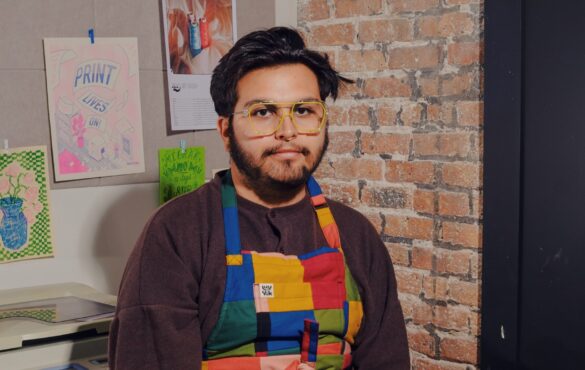
Spudnik Press is pleased to welcome Miguel Limón for a residency. During their time at the studio they will spend their residency untangling how heavy industry, community memory, and environmental policy overlap on Chicago’s Southeast Side. Their project, Foundry Echoes, centers on the former South Works steel mill and the generations of Mexican American families whose lives were bound to it. Rather than viewing the neighborhood’s vacant industrial lots as empty ground, Limón approaches the land as a physical record—one whose historical weight becomes critical to defend as new tech developments threaten to rewrite the area’s landscape once again.
Limón’s approach treats the printing process as a tool for excavating the past. Working across paper and fabric, they construct complex visual layers by combining site maps, archival photography, and raw line work. By incorporating iron oxide and rust pigments directly into the ink and fibers, the physical surfaces reflect the actual chemical and material history of the land, using transparency and texture to make the quiet work of memory visible.
By drawing on neighborhood oral histories alongside historical records, Limón points to local environmental organizing as a central feature of the post-migrant journey. The resulting prints reframe the remnants of industry not as industrial decay, but as testament to the resilience and placemaking of the workers who sustained the region.
Miguel Limón is a Chicago-based artist and cultural worker whose practice examines how images, materials, and local geography preserve memory and spirit. Their research focuses on Midwestern Mexican American communities shaped by industrial labor and migration. Limón is a 2025–2027 Chicago Artists Coalition Artist-in-Residence and holds concurrent residencies at Spudnik Press and Kimball Arts Center. They have received recognition and grant support from A Blade of Grass, 3Arts/Ignite, the Aperture Foundation, and the Rauschenberg Foundation, with work exhibited at Comfort Station, Mana Contemporary, and the Design Museum of Chicago.