Posts Categorized: Category

April 17 | Studio Access Training: Relief, Monoprint, Intaglio

Studio Authorization is always required prior to attending your first Open Studio or becoming a Keyholder. Experience is required for all Studio Access Trainings. Authorizations are free or you can pay what you can as a donation to Spudnik!

Please take some time to read and ensure that you meet the minimum requirements stated below.

What Are Studio Access Trainings?


Studio Access Trainings ensure that those with have prior experience from school or another print studio will be proficient and confident using the equipment in our studio.


What you can expect:

These sessions are NOT lessons, but specifically for makers who already have thorough experience with similar equipment. 

Minimum Requirements to Become Authorized:

  • Have recent experience with the equipment you would like to use (within 2 years)
  • Have thorough experience with the equipment you would like to use (8-week class or equivalent; Experience required varies based on process and equipment).
  • Be comfortable working independently.
  • Demonstrate safe and clean printmaking or art-making habits.
  • Demonstrate respect to our staff and our equipment.


If you do not meet these requirements, please enroll in a class that includes authorization or schedule a series of private lessons. 

Studio Access Training: Relief, Monoprint, Intaglio


This authorization focuses on press safety.

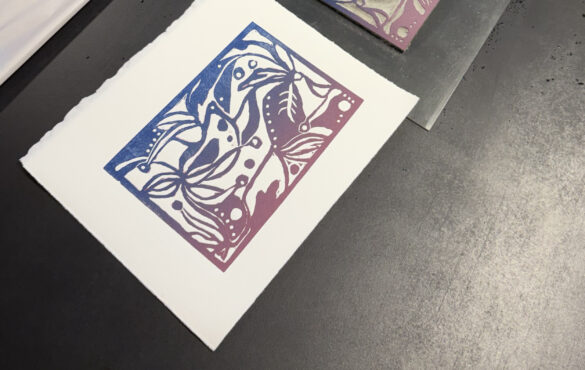
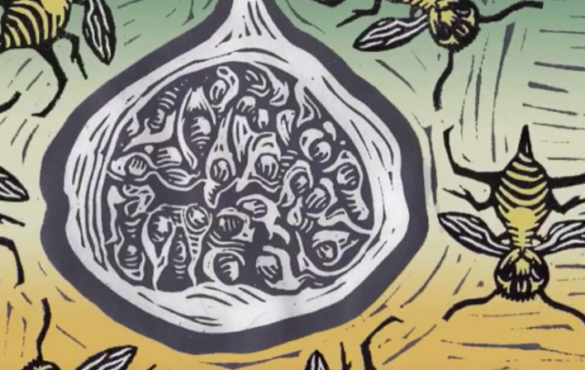
Within relief printmaking, this session will address the basics of block carving with a focus on the tools and resources available at Spudnik Press and how various carving styles or approaches might affect the printing process. While printing with a press will be reviewed in detail, printing by hand will be addressed on request.

Within monoprinting, this session will address using plexiglass as a matrix, working with water- and oil-based pigments, and mark-making and stencil-making tools on site.

Moving to the printing process, this session will address setting pressure, blanket care, registration methods, paper selection, working with wet paper (water baths and damp packs), and drying/flattening prints. Regarding ink, this session with review modifiers, ink care, and cleaning expectations.


For intaglio artists,  the training will focus on personal safety, care and maintenance of tools and supplies, and best practices for working with intaglio printing at Spudnik Press.

As with all our Studio Access Trainings, we will also cover equipment available to check out and press reservation policies.

April 18 | Family Screenprinting: Screenpainting (2 Hours)

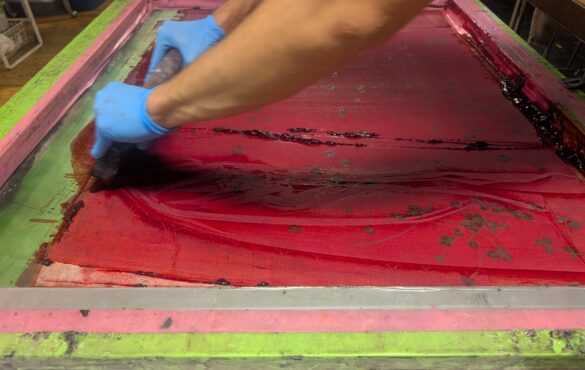
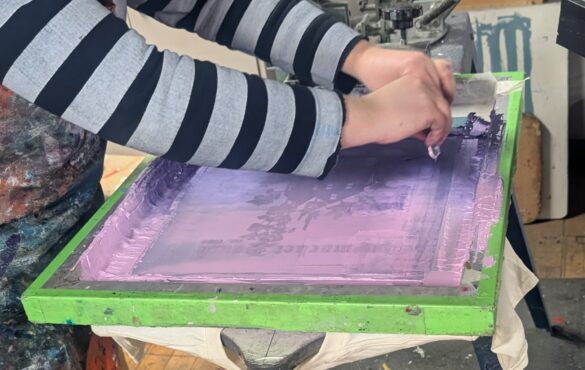
Explore screenprinting with your family through one of its most improvisational and expressive techniques: screenpainting. Using dry pigments or watercolor paints applied directly to the screen, participants will collaborate to create bold, unexpected marks and textures not typically associated with traditional screenprinting.

All materials and instruction are provided, making it easy to jump in and experiment. Families will produce a series of monoprints and ghost prints that can stand alone or serve as a base for further refinement. No computers required—just hands-on making and creative play.

Each registration includes up to four participants of all ages. You’re welcome to attend with the people you consider family. So bring the people closest to you and enjoy creating together.

April 20 | Drypoint Printing (4 Hours)

This workshop is great for ambitious beginners curious about intaglio techniques. The drypoint process covers the basic skills needed to become familiar with etching and other intaglio processes, and therefore would set students up for further success with intaglio in the future.

Students will learn drypoint techniques, plate wiping techniques, and gain familiarity with intaglio printing. Students will leave with a finished drypoint plate and print, as the class hours will be devoted to learning technique versus creating a perfected artwork.

April 23 | Screenprinting Refresher & Authorization (4 Hours)

Note: Experience is required to take this refresher class.

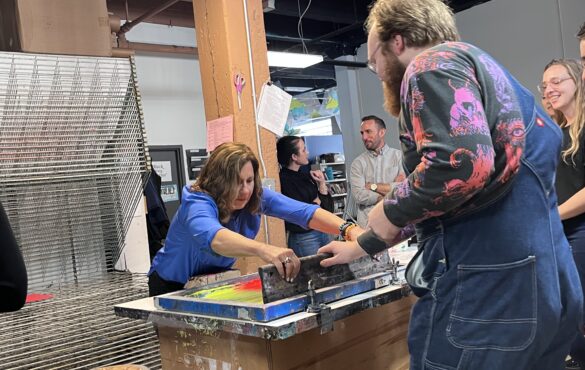
This refresher & authorization workshop welcomes students with previous screenprinting experience who are feeling out-of-practice or fuzzy regarding the finer points of the process, or who have never printed at Spudnik before, and want familiarity with our facilities and offerings. Students should have already completed a one-day workshop or full class, although it need not have been at Spudnik. We also welcome printers that would like support working through a particularly complex project or reoccurring printing issue.

The class will review an assortment of skills such as selecting the best mesh count, applying the perfect coat of photo emulsion, troubleshooting and diagnosing exposure and printing issues, ink mixing, registration, and screen reclamation. Equally as importantly, we will address how to consider these technical factors and limitations when designing a project for printing.

During the workshops, each student will expose a screen, and work with peers to print a two-color image designed to hone nuanced printing skills. Students are welcome to bring specific questions about their next project.

To help build printing confidence at Open Studio sessions, students are invited to return within the week to put their freshly acquired knowledge to use. Through this workshop, students will not only brush up on old skills and become authorized to print at Spudnik, but are sure to walk away with new morsels of useful information regarding the art of screenprinting.

April 26 | Bookbinding 101 (4 Hours)

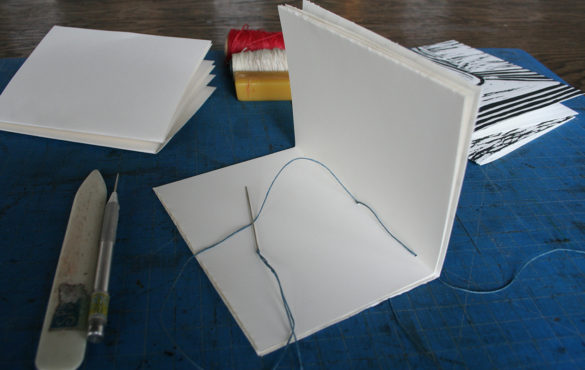
This workshop focuses on styles of bookbinding that are low-cost yet dynamic, and well suited for poetry chapbooks and portfolio books. Students will learn how to choose materials and create simple book structures that best highlight the content within their book.

The lessons will address the logistics of organizing book forms and explore the book as a vessel for information, and how material choices can inform how the book is read. While the workshop will create blank books, each style of binding will begin with standard 8.5” x 11” paper to allow your content to be easily printed from a common inkjet or laser printer.

May 10 | Design for Print: Thinking Through Color — Understanding Single Color Production with the Risograph

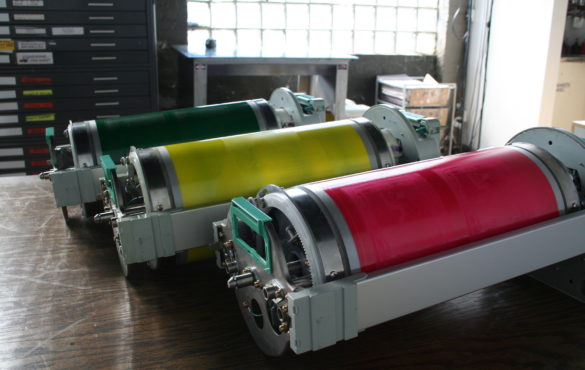
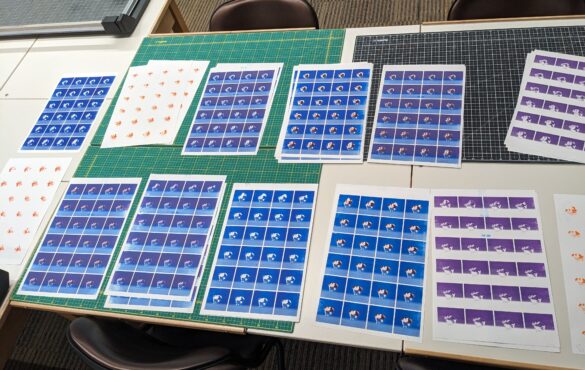
Print is, at its core, a subtractive and sequential medium — color is built layer by layer.  For designers who have worked primarily on a computer screen, developing an intuition for how color behaves in print is about reorienting how you see. This workshop, led by designer and educator Amira Hegazy, digs into the thinking behind color separation: how an image is decomposed into its constituent parts, how printing inks interact, and how the relationships between layers are designed rather than assumed. The Risograph serves as the workshop’s primary teaching instrument — its single-color-at-a-time process makes visible what is often invisible in more automated digital print workflows, giving designers a direct, tactile experience of the logic that underlies every multi-color print process, from offset lithography to screen printing.


This is the first workshop in the Design for Print sessions with Amira Hegazy

This workshop series is built for designers and other digital image makers to translate their digital skills to physical making. We will take specific elements of the design process and decode them to print processes. We will highlight historical and theoretical elements that have woven through design practice from days of physical production to our digital workspaces. Expect to leave each workshop feeling more knowledgeable about your day-to-day design workflows and how to realize your designs through hands-on print practices at Spudnik Press. 

Amira Hegazy is a Chicago-based designer, printer, bookmaker and educator whose work lives at the intersection of print, publication, and community. This four-part workshop series is designed specifically for graphic designers looking to deepen their print knowledge — from file setup to finished object.

May 17 | Design for Print: Slow Type — Letterforms & Typesetting on the Letterpress

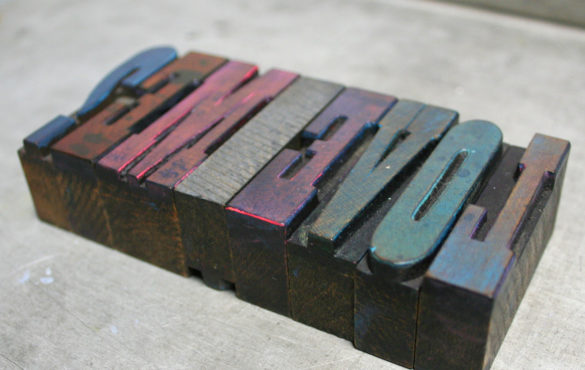
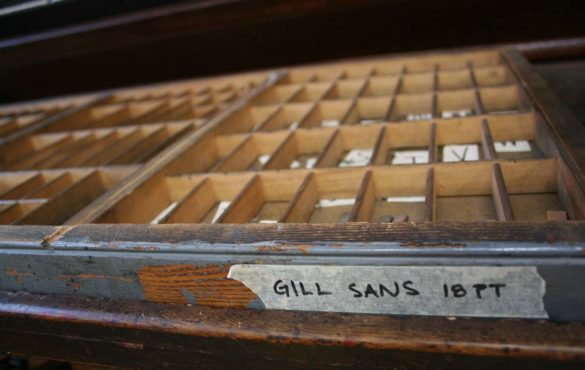
Designers work with type constantly, but often take for granted the rules and nuances of elegant typesetting and type design. This workshop, led by Amira Hegazy, is an invitation to slow down and develop a more considered relationship with letterforms: their history, their construction, and the decisions embedded in their design. Drawing on a survey of typographic history, the session moves into a close examination of letterform anatomy — the relationships between strokes, counters, spacing, and proportion that give each type its unique voice. The workshop culminates in a hands-on letterpress activity, where setting type by hand makes abstract principles concrete. There is no better argument for understanding type as a physical, spatial thing than having to reckon with it as one.

This is the second workshop in the Design for Print sessions with Amira Hegazy

This workshop series is built for designers and other digital image makers to translate their digital skills to physical making. We will take specific elements of the design process and decode them to print processes. We will highlight historical and theoretical elements that have woven through design practice from days of physical production to our digital workspaces. Expect to leave each workshop feeling more knowledgeable about your day-to-day design workflows and how to realize your designs through hands-on print practices at Spudnik Press. 

Note: Each workshop in this series is enrolled individually. You can register for a single workshop or sign up for the full series.

Amira Hegazy is a Chicago-based designer, printer, bookmaker and educator whose work lives at the intersection of print, publication, and community. This four-part workshop series is designed specifically for graphic designers looking to deepen their print knowledge — from file setup to finished object.

May 24 | Design for Print: Designing for the Printed Book

Designing a book digitally can feel linear, spreads seamlessly connect and sequencing is quick and direct. But, a physical book is an object with its own logic. Books make demands that a computer screen never does — it has a spine, a sequence, a physical weight, and a relationship between recto and verso that no amount of scrolling can replicate. For designers, working in the book format means grappling with a set of structural and spatial considerations that are distinct from any other medium: how content is organized across a signature, how imposition shapes what is possible on press, how the rhythm of a layout accumulates across pages rather than resolving on one. 

This workshop, led by Amira Hegazy, approaches the book as a design problem in the fullest sense — one where form and content are inseparable, and where every decision, from margins to binding method, is also an editorial one. This workshop briefly explores the historical development of book form and how physical possibilities of the book have developed with the needs of production and readers.  Whether you are working on a zine, a monograph, an artist book, or a longer publication, the workshop offers both practical grounding and a more expansive framework for thinking about what a book can do.

This is the third workshop in the Design for Print sessions with Amira Hegazy

This workshop series is built for designers and other digital image makers to translate their digital skills to physical making. We will take specific elements of the design process and decode them to print processes. We will highlight historical and theoretical elements that have woven through design practice from days of physical production to our digital workspaces. Expect to leave each workshop feeling more knowledgeable about your day-to-day design workflows and how to realize your designs through hands-on print practices at Spudnik Press. 

Amira Hegazy is a Chicago-based designer, printer, bookmaker and educator whose work lives at the intersection of print, publication, and community. This four-part workshop series is designed specifically for graphic designers looking to deepen their print knowledge — from file setup to finished object.

May 31 | Design for Print: Containers — Presenting Your Work Through Box Building

Presentation is not packaging — it’s a critical design decision, the one that determines how a body of work is first encountered and held. For printed matter especially, the container is an extension of the object itself: it sets expectation, establishes care, and frames everything inside it. 

This workshop, led by Amira Hegazy, focuses on the design and construction of custom enclosures to explore how structure, material, and proportion work together to create objects worthy of what it holds. Participants will build their own boxes by hand, developing both the technical vocabulary and the design sensibility to think about containment as an intentional act. We will discuss how engineering containers go hand in hand with print design preparation and consider how the design and fabrication process are inseparable. Essential for designers working with product development, book editions, print portfolios, or any work where the experience of receiving matters as much as the work itself.

This is the fourth workshop in the Design for Print sessions with Amira Hegazy

This workshop series is built for designers and other digital image makers to translate their digital skills to physical making. We will take specific elements of the design process and decode them to print processes. We will highlight historical and theoretical elements that have woven through design practice from days of physical production to our digital workspaces. Expect to leave each workshop feeling more knowledgeable about your day-to-day design workflows and how to realize your designs through hands-on print practices at Spudnik Press. 

Amira Hegazy is a Chicago-based designer, printer, bookmaker and educator whose work lives at the intersection of print, publication, and community. This four-part workshop series is designed specifically for graphic designers looking to deepen their print knowledge — from file setup to finished object.